
Mesureur de potentiel d'oxydation-réduction (ORP) – ORPSense
La gamme de mesureurs de potentiel redox (ORP) ORPSense de Pi utilise les capteurs ORP les plus récents et les plus performants actuellement disponibles sur le marché pour mesurer en continu le potentiel redox de toute solution aqueuse. Il s’agit de capteurs à bille de platine avec électrode de référence intégrée qui ne nécessitent aucun réactif, sont extrêmement stables et présentent des coûts de maintenance et de cycle de vie réduits.
Un pH-mètre ORP fiable et abordable
Les pH-mètres ORP en ligne et les contrôleurs ORP comptent parmi les analyseurs les plus couramment utilisés aujourd’hui dans les usines de traitement de l’eau et les installations de traitement, et pourtant, les pH-mètres ORP en ligne posent des problèmes constants à leurs opérateurs. Ce qu’il faut, c’est un pH-mètre ORP en ligne stable et fiable, à un coût raisonnable. C’est exactement ce que vous offre l’ORPSense.
Les capteurs et les cellules de mesure ORPSense sont disponibles avec différents contrôleurs, vous offrant les mêmes performances exceptionnelles avec différentes options de communication, d’affichage et de contrôle. Avec la gamme de mesureurs ORP ORPSense, vous obtenez tout ce dont vous avez besoin – et rien de superflu.
Principe de fonctionnement
Le capteur au cœur du pH-mètre/ORP-mètre en ligne de Process Instruments est une électrode en verre remplie de polymère brevetée. Cette électrode ORP est de loin supérieure à de nombreuses électrodes ORP de process en ligne disponibles sur le marché ; elle est conçue pour offrir une longue durée de vie, une faible dérive et une grande fiabilité. Contrairement à de nombreux analyseurs ORP, vous n’avez pas besoin de passer au crible des centaines d’électrodes ORP pour en trouver une qui fonctionne dans votre processus, car l’électrode ORPSense fonctionne dans tous les environnements, de pH 2 à 12 et pour une conductivité à partir de 0 µS. Bien qu’ils soient proposés à un prix plus élevé sur le marché, ces capteurs sont plus qu’économiques grâce à leur durée de vie plus longue et à leurs besoins d’entretien considérablement réduits, ne nécessitant généralement qu’un étalonnage tous les deux ou trois mois. Malgré toutes les fonctionnalités supplémentaires qu’offre cet appareil, son coût d’achat est inférieur ou comparable à celui de ses concurrents!
Le moniteur ORPSense élimine la nécessité pour les opérateurs de procéder à un étalonnage et à un réétalonnage continus du pH-mètre, car il utilise une électrode de pH extrêmement stable. L’ORPSense calcule un « degré de confiance » dans son propre étalonnage et vous avertit si ce degré est faible. Si le pH-mètre détecte un défaut au niveau du capteur ORP, il affiche des instructions sur l’écran indiquant la nature possible du défaut, grâce à un système complet de diagnostic intégré.
Le pH-mètre en ligne est capable d’un contrôle PID complet et est équipé d’options de contrôle de processus, d’enregistrement de données, de sorties relais et de communications série. L’accès à distance au pH-mètre (y compris l’accès à toutes les options de contrôle) est disponible via Internet et via un réseau local (LAN). En fait, l’ORPSense offre toutes les options que vous pourriez souhaiter dans un pH-mètre, tout en restant économique et en offrant un excellent rapport qualité-prix.
Principaux avantages
Applications
Options
Zoom sur
Downloads
- Appareil de mesure du potentiel redox stable et fiable
- Système de diagnostic intégré
- Faible coût d’acquisition
- Capteurs de potentiel redox à longue durée de vie
- Accès à distance et alertes par SMS
- Régulation PID et autres systèmes de contrôle des processus
- Remote Sites
- Cooling Towers
- Food Preparation
- Paper Mills
L’ORPSense est idéal partout où il est nécessaire de mesurer le potentiel d’oxydoréduction (ORP). La gamme de mesureurs ORPSense est particulièrement adaptée aux sites où la fiabilité et la facilité d’utilisation sont primordiales.
AutoFlush
Comme indiqué ailleurs, l’ORPSense peut être équipé d’un système de nettoyage automatique à des intervalles définis par l’utilisateur, offrant ainsi tous les avantages d’une utilisation sans intervention de l’opérateur. La fonction AutoFlush est particulièrement utile dans les secteurs de la transformation alimentaire, de la pâte à papier et du papier, ainsi que dans de nombreuses applications où l’on risque d’observer une accumulation de matières solides dans l’échantillon.
Systèmes à capteurs multiples
Toute la gamme de pH-mètres ORPSense peut être équipée de capteurs supplémentaires, tels que des capteurs de chlore ou de pH. Veuillez contacter votre distributeur local pour plus de détails.
Toute la gamme de pH-mètres ORPSense peut être équipée de capteurs supplémentaires, tels que des capteurs de chlore ou de pH. Veuillez contacter votre distributeur local pour plus de détails.
Focus On… ORP for the Removal of Residual Chlorine using Sodium Bisulphite (or other reducing chemicals)
Chlorine is often removed from a process and there are a number of potential reasons why. Chlorine might damage an RO membrane or turn food brown in an unsightly manner. Chlorine removal presents several challenges to instrumentation manufacturers and engineers, but did you know that…
…ORP can effectively control sodium bisulphite dosing to remove chlorine?
…ORP can limit the dose of excess sodium bisulphite which can lead to problems later in the process?
…ORP is very sensitive to changes in chlorine at very low levels?
How do you effectively control chlorine removal?
Logically, it would be perfectly reasonable to take a standard chlorine probe and dose a reducing agent such as sodium bisulphite until the probe gets to zero. Then if the probe does increase from zero, dose more reducing agent.
Unfortunately due to the inherent electrochemical properties in chlorine sensors, this perfectly logical solution won’t work. This is because amperometric chlorine probes require the presence of some chlorine in order to function properly. This is generally called polarisation and the longer a probe has been in water without chlorine, the longer it will take to see chlorine when it is reintroduced. This isn’t due to manufacturing quality or to design flaws. This is a fundamental electrochemical property that is hard to engineer out. Some amperometric probes are more resistant to this effect than others. They are suitable for applications where chlorine may intermittently reach zero, or where the probe can be periodically reset in chlorinated water (typically potable water). Pi’s HaloSense Zero has been built with this in mind. This amperometric zero chlorine sensor is being successfully used in RO membrane applications and many other low-level chlorine processes.
However, in applications where reducing agents are used to remove chlorine, a more elegant solution is to use ORP. An ORP sensor measures oxidation reduction potential. The reaction between chlorine and a reducing agent is a reduction-oxidation (redox) reaction. This means that ORP can be used to control this process and can ensure the removal of chlorine, whilst simultaneously preventing the overdosing of a reducing agent.
Below is a simplified example of the reaction between HOCl (free chlorine) and NaHSO3 (sodium bisulphite).
- 2NAHSO3 + 2HOCl → H2SO4 + 2HCl + Na2SO4
When free chlorine is in excess, the ORP is raised and when sodium bisulphite is in excess, the ORP is lowered.
At low levels, a very small change in the concentration of chlorine will result in a large change in ORP. This is because the relationship between ORP and the concentrations of oxidants and reducing agents is logarithmic. The same also goes for the concentration of reducing agent (such as bisulphite), once an excess has been reached. The ORPSense from Pi can be used to control chlorine removal. An ORP titration curve is necessary to choose a setpoint for ORP. The graph shows a typical ORP titration curve, though the exact values will be different for each process. It is important to test each new installation and to adjust the ORP setpoint accordingly. Once this titration curve has been determined, there is no continual calibration involved with ORP sensors.
It is worth acknowledging that ORP can be affected by many other variables in the process water, such as conductivity, pH or temperature, and that this method of control won’t be suitable for all processes. Combined with Pi’s CRONOS® or CRIUS®4.0 controller, Pi’s ORPSense can be installed alongside other sensors like the zero chlorine sensor, pH or conductivity sensors to help give you a more complete picture of your process.
If you need to control a process where chlorine is removed with chemicals, a carbon filter or even with UV, Pi can help you by providing world class instrumentation and application expertise.
NB. This Focus On is about the removal of chlorine, however, many principles in this Focus On can be applied to other oxidants such as chlorine dioxide.
Focus on… Probe Fouling
Many different sites ranging across the whole water industry have a daily struggle to keep instrumentation functioning correctly due to fouling. However, did you know that…
…self cleaning and self flushing systems are now available from Process Instruments for most types of sensors?
…these fouling removal systems can extend the life of sensors and drastically reduce maintenance regimes?
…Pi’s self cleaning/flushing systems are affordable, simple and trouble free by design?
Sensor Fouling
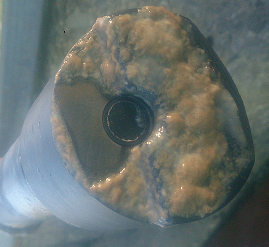 Whatever the process being monitored is, there is often something in the sample water capable of fouling a sensor, and therefore causing erroneous results. The obvious solution to this problem is to clean the sensor, but how regular should inspection and cleaning programs be for each piece of instrumentation? Too regular and the inspection and cleaning regime is time consuming and unnecessarily costly. Not often enough and the instrumentation will give false results and probably fail prematurely.
What is the solution?
Process Instruments’ AutoClean and AutoFlush Systems
Simple, reliable and easy to maintain, Process Instruments’ AutoClean/AutoFlush systems are an alternative to mechanical cleaning mechanisms which can clog and break. By regularly spraying the sensor/probe with clean water or air, the sensor remains clean and free from fouling for extended periods of time. The sensor cleaning cycle is activated by Pi’s controller for a user selectable length of time and frequency so that no matter how dirty the application, the probe remains clean. With no moving parts in the sensor body or in the cleaning attachment there is nothing to replace or check other than a simple valve positioned in an easy to reach location. Pi’s AutoClean and AutoFlush systems can give trouble free and fouling free functioning of sensors for weeks, if not months, at a time.
A solution for each application
AutoClean
This option can be added to our pH, ORP, Turbidity, Suspended Solids and Dissolved Oxygen (DO) sensors. Consisting of an end cap to direct the flow of clean water (or air for a DO sensor) across the face of the sensor blasting any dirt away. The cleaning is controlled by a single valve positioned in an easily accessible location.
AutoVerify
 If using air to clean a DO sensor the system can also automatically verify that the sensor is still responding correctly, removing any need to remove the sensor from the sample for months at a time.
AutoFlush
For sensors that require flow cell mounting like Chlorine, Ozone and Chlorine Dioxide, an Autoflush system has inbuilt valves which automatically start/stop the sample flow and control the flow of clean water past the probe. The user can set the flushing interval and duration to keep the flow cell and sensor clear from fouling. For particularly dirty or stubborn contaminants, warm water can be used as the flush water to aid cleaning.
With the above options, whatever the application or parameter being measured, Process Instruments will be able to provide a monitoring system that will not only be accurate, precise and long lasting but that will also remain free from fouling and save the operator both time and money.
Focus On… ppm Chlorine vs. ORP measurement
You probably know that some instruments use ORP to control chlorine dosing and others use ppm chlorine sensors but did you know that…
…ORP over about 3ppm won’t work?
…swimming pools in the USA use ORP and in Europe use ppm chlorine sensors?
…the ORP of towns water can vary a great deal? In the USA nearly all pools and spas use ORP sensors to control their chlorine dose, yet conversely in the UK and Western Europe most ORP systems have been replaced with systems that measure the concentration of free chlorine in water. Pi provides systems that utilise either or both technologies.
ORP
Oxidation reduction potential (ORP or REDOX) sensors, measure the tendency of water to gain or lose electrons from anything in the water. The more positive a reading from an ORP the greater the tendency the water has to oxidise (gain electrons from) organisms or other material in the water, thereby killing or destroying them.
Why do so many pools in the USA use ORP?
When chlorine is dosed into a pool it form OCl– and HOCl. Disinfection is largely done by the HOCl and ORP responds to the concentration of HOCl in the water, which makes it a good measure of the tendency of the chlorine in the water to kill bugs. Despite this, ORP is a secondary measure of HOCl and is affected by a multitude of other factors, some of which will be touched on below. The main attractions of ORP are; low purchase cost, no calibration and little or no maintenance.
What are the problems with ORP sensors?
 Unfortunately, what ORP sensors measure is tendency and not capacity, i.e. ORP measures the likelihood or the ability of the water to kill bugs, but not how many bugs that water can kill, a subtle but very important difference. A sample with high ORP may be able to kill a small number of bugs very quickly but then not be able to kill future pollution. What’s more, although chlorine affects ORP very strongly it is not the only variable involved. The pH of water affects ORP directly and also affects the concentration ratio of OCl–/HOCl, the two main disinfectant components. A lower pH (higher acidity) will cause an increase in the relative concentrations of HOCl causing an increase in ORP.
Perhaps the biggest issue with ORP is that the ORP readings on water with no chlorine in it will be different depending on the source of that water. This means that an ORP of 750mV in one part of the country is not the same chlorine concentration as 750mV in another part of the country. Also the ORP response to HOCl is not linear and increasing residual chlorine above 3 ppm has little effect on ORP readings making control above 3 ppm extremely difficult. These issues typically lead to overdosing the water with chlorine, in order to compensate for these effects. This can be seen very clearly in US pools which often have more than 2 ppm of chlorine compared to European pools which typically operate around 0.8-1.5 ppm (The World Health Organisation recommends 1 ppm residual).
ppm Chlorine
 These sensors use electrochemistry to measure the free chlorine concentration directly. They tend to be slightly more expensive than an ORP sensor, but are more reproducible and precise, and therefore tend to give better control (and therefore reduced chemical cost). They are specific to free chlorine (the disinfectant) and can be easily calibrated using a DPD test for free chlorine. Whilst the capital cost for a ppm chlorine sensor is higher, total cost of ownership tends to be lower as ORP sensors are typically replaced every year and ppm sensors last for ten years or more.
Problems with ppm Chlorine sensors
A ppm sensor measures the capacity of water to kill organisms, the only problem is that it doesn’t measure how fast the bugs are killed, a variable largely down to pH. There are two different types of ppm sensors. The first measure only HOCl, and have very similar problems to ORP sensors. The other type of sensor, in pHs below 8.0, measure both HOCl and OCl–. Pi only recommends the use of sensors that (for use in pools) are independent of pH, and the use of pH control that is independent of chlorine dosage. This leads to tighter control of both pH and free chlorine meaning chlorine residuals can be more tightly controlled and reduced, which in turn leads to lower costs and a more pleasant bathing experience.
Conclusion
Advantages | Disadvantages |
|---|---|
ORP SensorsSimple (no calibration)Inexpensive | ORP SensorsDoesn’t measure disinfection capacityAffected more by pH than by free chlorine Non-Linear Not reproducible (not the same from site to site) Affected by changing water chemistry Affected by all oxidants Using ORP control normally leads to higher residuals and less stable control |
ppm SensorsMeasure free chlorine directlyResults comparable across different sites Linear response Only affected by free chlorine Using a ppm sensors leads to lower residuals, more stable control and better swimmer experiences | ppm SensorsRequires calibrationMore expensive – but not much More maintenance – but not much |
| Document | Type | Size |
|---|---|---|
| ORPSense | Brochure | 666kB |
| ORP Selection | Brochure | 730kB |
| ORP vs. ppm | Technical Note | 534kB |
| Probe Fouling | Technical Note | 459kB |
"The support from Pi and its partners is superb. They go above and beyond to ensure that, not only is their equipment perfect but that the process is working great too. Five Stars!"
Anthony Glitto
Equip Solutions - Illinois, USA
Everyone at Pi goes out of their way to be supportive and timely. Their expertise is unchallenged and I am very happy to endorse them as a quality supplier.
John Clark
Chemtrac - Georgia, USA
Servicing customers is much more than just solving problems or addressing complaints and Pi does that very competently with technical and quick efforts providing a good experience.
Clovis Tuchapski
Buckman - Latin America